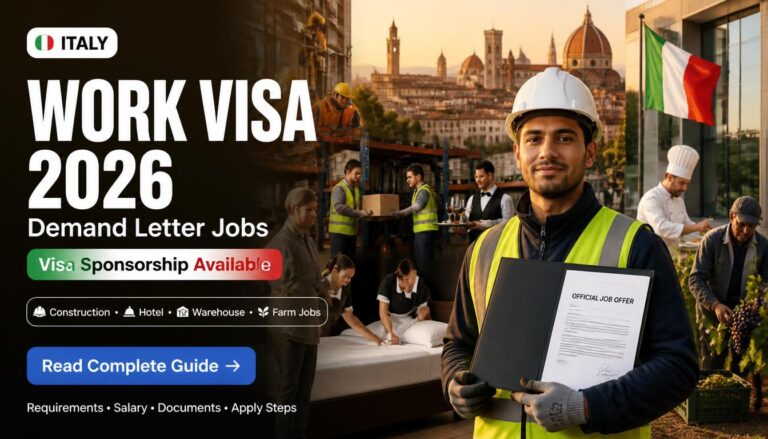
Italy Work Visa 2026: Demand Letter Jobs With Sponsorship
A construction worker from Ghana once told a simple story: one signed job offer from an Italian employer changed his entire year. That single “demand letter” was the document that made his work visa possible.
Italy regularly opens pathways for foreign workers across construction, hospitality, agriculture, and logistics roles. These jobs typically work through an employer-issued demand letter — essentially a formal job offer that supports your visa application.
This guide explains who can apply, what documents you’ll need, and how the process really works — without guesswork or false promises.
Let’s start with the basics.
🇮🇹 What Are Italy Demand Letter Jobs and Why They Matter
Italy relies on foreign labor to fill roles that local hiring alone can’t cover, especially in construction, hospitality, farming, and warehouse work. Certain roles — such as construction workers, electricians, plumbers, masons, farm workers, hotel housekeepers, waiters, chefs, and warehouse workers — are commonly filled this way.
The demand letter is simply a formal offer from a real Italian employer, confirming they want to hire you. This letter is often a required step before you can move forward with a work visa application.
This matters to you because it’s a genuine route into European employment that doesn’t always require a university degree — trade skills, hospitality experience, or a willingness to do physical labor often matter more.
Now let’s look at who can actually apply.
👤 Who Can Apply: Eligibility & Requirements
Requirements vary by role and by employer, but common expectations include:
- Being 18 years or older
- Relevant skill or trade background for the role (e.g. construction, cooking, housekeeping)
- Basic education (varies — skilled trade roles may require certification)
- Basic English or Italian communication ability
- Physical fitness for labor-intensive roles (construction, farm work, warehouse work)
- A clean background check in many cases
| Requirement | Typical Range |
|---|---|
| Age | 18–45 (varies by program) |
| Education | High school minimum (varies by role) |
| Experience | Often required for skilled trades (electrician, plumber, chef); less for general labor |
| Language | Basic Italian or English; formal test rarely required |
| Nationality | Check official eligibility list |
If you meet most of these, you’re already ahead. Here’s what documents you’ll need.
📄 Documents You Need to Prepare
Gather these before you start applying:
- Valid passport — with enough validity remaining to cover your contract
- Passport-size photos — meeting official visa photo requirements
- Proof of education or trade certification — especially important for electricians, plumbers, and chefs
- Work reference letters — relevant experience strengthens your application
- Medical exam results — often required, especially for labor-intensive roles
- Police clearance certificate — from your home country
- Signed demand letter / job offer — from the sponsoring Italian employer, once secured
📌 Pro Tip: Prepare all documents as clear PDF scans before starting — it saves time and reduces rejection risk.
Once your documents are ready, here’s exactly how to apply.
🛂 How to Apply: Step-by-Step Guide
- Search official job boards and licensed recruitment platforms — avoid random social media posts promising guaranteed visas.
- Verify the employer is real by checking they’re a registered Italian business with a genuine hiring need.
- Apply directly to the job listing with your CV and relevant trade or work documents.
- Receive a formal demand letter (job offer) — this is typically the key document your visa application will need.
- Submit your work visa application through the relevant Italian embassy or consulate, using the demand letter as supporting evidence.
- Attend a visa interview or provide biometrics if requested.
- Wait for approval, then arrange travel once your visa is issued.
⚠️ Important: Never pay a third party to “guarantee” your application. Legitimate government and employer processes charge official fees only, directly, with a receipt. Anyone demanding side payments for a demand letter or “guaranteed” visa slot is very likely a scammer.
After submitting, here’s what typically happens next.
💰 Salary, Benefits & Contract Details
Pay for demand letter jobs in Italy varies significantly by role, region, and employer — skilled trades like electricians and chefs generally earn more than general labor or entry-level hospitality roles. A commonly cited general range for these types of roles is roughly €1,300–€3,000 per month, but this should be treated as a broad market estimate, not a guaranteed figure — [VERIFY: current typical salary range by role and region before publishing].
Common benefits include:
| Benefit | Commonly Included? |
|---|---|
| Wages (monthly) | Yes — check the specific job offer for exact rate |
| Accommodation | Sometimes, especially for farm and hospitality roles |
| Transport | Sometimes, varies by employer |
| Medical insurance | Often required by law for workers |
Contracts range from seasonal (farm work, hospitality) to longer-term renewable contracts (construction trades). Many workers report earning considerably more than comparable work at home, though the real difference depends heavily on your home country’s wages.
📅 Timelines & Deadlines
Italy’s foreign worker intake often follows an annual cycle, with application windows opening during specific periods set by the government each year. Because these windows can close quickly once quotas fill, demand for demand letters tends to build well in advance.
Applying early — securing your employer offer and documents ready — gives you a real advantage. Always confirm current intake dates and quota status on the official Italian immigration or consulate website, since these change every year.
🌍 Countries & Nationalities That Can Apply
This pathway is generally open to applicants from many countries, including Nigeria, Pakistan, Bangladesh, India, the Philippines, Ghana, South Africa, Vietnam, and Indonesia. Specific quotas and eligibility can vary by nationality and by year, so always confirm the current rules for your country on the official Italian government or consulate page before applying.
❓ FAQs
Is this free to apply? Applying to a genuine job posting is typically free. You may still owe standard government visa fees, but no employer or agent should demand extra “guarantee” payments for a demand letter.
Do I need to speak Italian? Not always, especially for general labor roles, but basic Italian helps significantly and some roles (like waiter or chef) may require it.
Can I apply with no experience? It depends on the role. General labor, farm work, and warehouse roles are often open to beginners; skilled trades like electrician or plumber usually require relevant training or certification.
How long does the process take? It varies widely by country, employer, and the government’s annual intake schedule — often several weeks to a few months from job offer to visa approval.
What are my realistic chances? Chances depend on the employer, your documents, your skill match for the role, and quota availability that year. No one can honestly guarantee approval.
Is this legitimate, or a scam? Genuine opportunities exist, but scams targeting hopeful workers — especially fake “demand letters” sold for a fee — are common. Only trust official job boards and verified employers; never pay upfront for a “guaranteed” offer.
✅ Tips to Improve Your Chances
- Apply early, before annual intake windows close
- Double-check every document for accuracy before submitting
- Highlight any relevant trade certification or experience clearly
- Learn basic Italian phrases, even if not required
- Avoid any recruiter asking for upfront payment for a demand letter
- Keep copies of everything you submit
- Have a backup plan in case one application doesn’t succeed
Conclusion
Italy’s demand letter jobs offer a realistic pathway across construction, hospitality, farm work, and skilled trades — as long as you secure a genuine employer offer and prepare your documents correctly. Success comes down to verifying every step, avoiding scams, and applying directly to real employers. Start early, stay organized, and always confirm details on official sources. If this guide helped you, share it with someone else planning the same journey.
⚠️ Disclaimer: This article is published by Raja Umer on discover.thecryptoner.xyz for general informational purposes only. We are not a recruitment agency, visa consultancy, or scholarship provider. Figures and timelines mentioned are general estimates and may not reflect a specific current program. Always verify all details — fees, deadlines, and eligibility — on the relevant official government, employer, or institution website before applying or paying anything.
Check All Categories:
JOBS
Vissa & Immigration
Scholarship